
3DC Inc. (Headquarters: Sendai, Miyagi Prefecture, Japan; CEO: Takuma Kuroda) has confirmed, through joint research with Assistant Professor Yosuke Ugata, Professor Naoaki Yabuuchi, and their team at Yokohama National University, that adding 1 wt% of Graphene MesoSponge® (GMS), a carbon material developed by 3DC, to lithium-ion battery cathodes improves high-rate discharge performance.
In high-density, thick cathodes, the discharge capacity achieved at high currents was approximately 1.5 times that of cathodes using single-walled carbon nanotubes (SWCNTs).
The research findings have been published in the international scientific journal Advanced Energy Materials.
Key Findings and Highlights
・Research Findings
GMS facilitates the transport of both electrons and lithium ions. Compared to electrodes using single-walled carbon nanotubes (SWCNTs), which exhibit similar discharge capacities at low currents, GMS-containing electrodes maintained higher discharge capacities even at high currents.
・Value for Battery Development
Increasing cathode thickness and density makes it more difficult for lithium ions to move within the electrode. GMS helps alleviate this limitation and is expected to contribute to achieving both higher energy density and higher power output in batteries.
・Path Toward Commercialization
3DC aims to expand the application of GMS, particularly in areas requiring high-power batteries, such as backup power systems for data centers and industrial drones, as well as into the electric vehicle (EV) and semiconductor sectors.
The company is advancing joint development with battery and materials manufacturers in Japan and overseas, with the goal of achieving early commercialization.

Comment from Professor Naoaki Yabuuchi, Yokohama National University
"To increase the energy density of practical rechargeable batteries, it is essential to pack active materials as densely as possible within the electrodes. However, increasing the packing density of active materials makes it difficult to retain sufficient electrolyte within the electrodes, which is necessary for lithium-ion transport. As a result, improving energy density has traditionally come at the expense of charge and discharge performance.
GMS is a novel material with the potential to improve both energy density and charge/discharge performance, which have long been considered difficult to achieve simultaneously.
Furthermore, GMS is a unique material originally developed in Japan. I look forward to the day when GMS, a Japan-born innovation, contributes to improving the performance of rechargeable batteries used around the world and finds widespread applications in the future."

Comment from Takuma Kuroda, CEO of 3DC Inc.
"To improve battery performance, it is essential not only to identify the properties of new materials but also to understand how they function within electrodes and apply that knowledge to electrode design.
Through this joint research, we have demonstrated that GMS contributes to the transport of both electrons and lithium ions. We regard the academic validation of our ongoing development efforts toward commercialization as a significant step forward.
We aim to apply the insights gained through our collaboration with Yokohama National University to joint development with battery and materials manufacturers, as well as to further enhancing the value of GMS as a product.
We are also seeking research and development professionals who are passionate about turning research findings into commercial products."
Research Background
To achieve higher energy density in lithium-ion batteries, it is important to increase cathode thickness and densely pack the active materials responsible for charging and discharging. However, as more active material is packed into the electrode, the available pore space for electrolyte decreases, hindering lithium-ion transport. As a result, when discharging at high currents, it becomes difficult to fully utilize the cathode's inherent capacity.
Conductive additives such as carbon nanotubes facilitate electron transport, but in high-density, thick cathodes, it is also necessary to ensure sufficient pathways for ion transport. In this study, a layered oxide composed of lithium and nickel was used as the cathode active material to investigate the effects of GMS's three-dimensional carbon framework and internal pores.
Key Findings of This Study
The carbon framework of GMS provides pathways for electron transport, while the electrolyte retained within its nanoscale pores also contributes to lithium-ion transport. Through these two functions, the study demonstrated that three-dimensional transport pathways for both electrons and ions can be established even within high-density, thick cathodes.
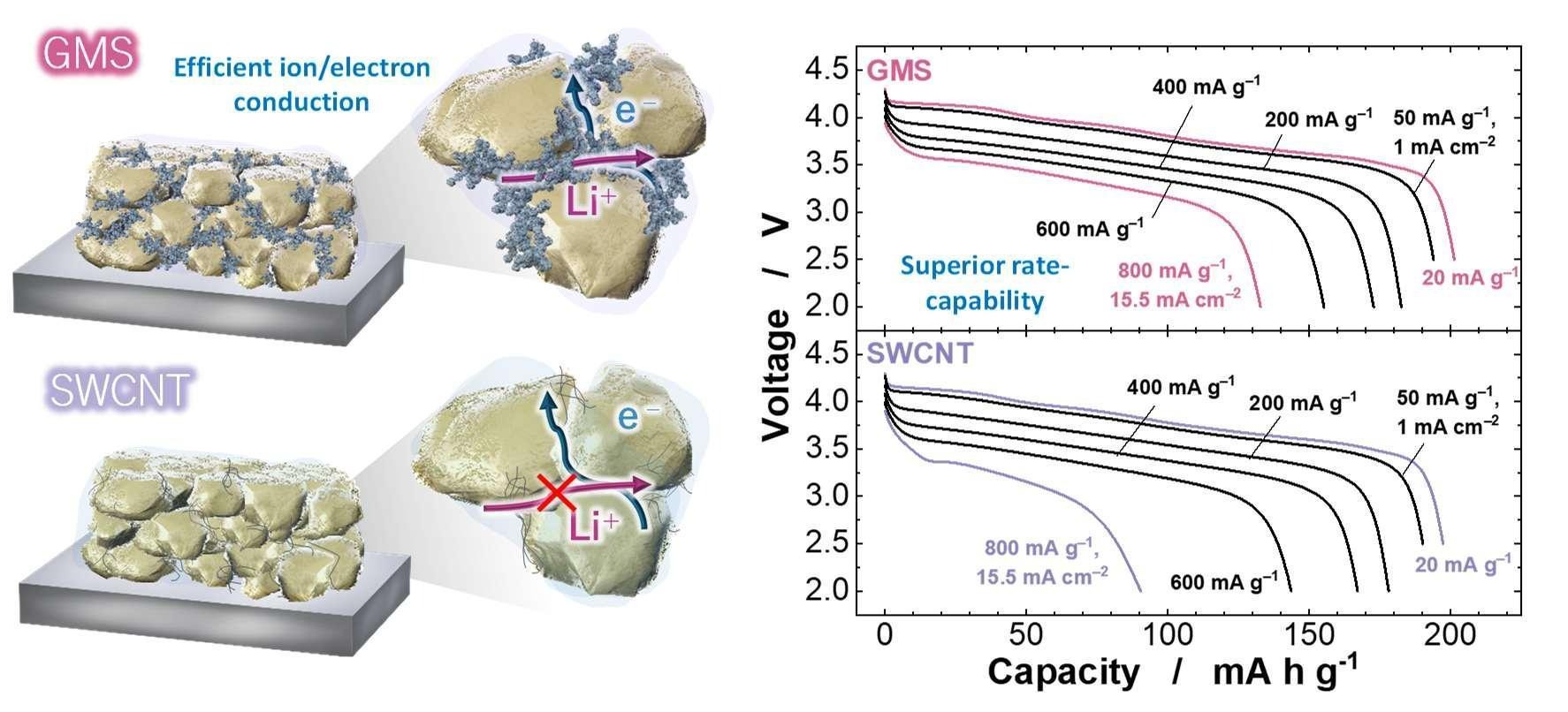
Simple Explanation: How Does GMS Work Inside an Electrode?
A battery electrode consists of a densely packed layer of particles that store lithium. Lithium ions move in and out of these particles through the electrolyte that fills the spaces between them. As electrodes become thicker and denser to store more energy, these spaces become narrower and more complex. Consequently, when a large amount of power is drawn at once, lithium ions cannot effectively reach the particles deep inside the electrode, preventing the battery from fully utilizing its stored energy.
Single-walled carbon nanotubes (SWCNTs) act as excellent "electrical wires" connecting the particles, but they cannot retain liquid within their structure. In contrast, GMS is a sponge-like carbon material that holds electrolyte within countless nanoscale pores. While providing pathways for electron transport, GMS also creates "channels" for lithium-ion transport throughout the densely packed electrode.
As a result, the discharge capacity achieved at high currents was approximately 1.5 times that of electrodes using single-walled carbon nanotubes (SWCNTs).

Additional Information and References
3DC began its joint research with Professor Yabuuchi in April 2024. The findings of this study were published online in the international scientific journal Advanced Energy Materials on October 8, 2026. Hiroshi Ueda and Kosuke Ishii, researchers at 3DC, also contributed as co-authors.
Paper Title: Unlocking Three-Dimensional Electron and Ion Transport in High-Loading and Dense Lithium-Ion Battery Electrodes Assisted via Porous Graphene Networks
Authors: Yosuke Ugata, Rei Matsumoto, Sera Sato, Jaejin Lim, Yong Min Lee, Hiroshi Ueda, Atsuo Omaru, Kosuke Ishii, Naoaki Yabuuchi
DOI: 10.1002/aenm.71677
Publication: https://doi.org/10.1002/aenm.71677
Source of Research Information: Press release issued by Yokohama National University
This research was supported by JST programs, including GteX (JPMJGX23S3), ASPIRE (JPMJAP2313, JPMJAP2528), and PRESTO (JPMJPR25M2).
Advanced Energy Materials is a leading international scientific journal in the field of energy materials, published by Wiley-VCH, a German publisher within the Wiley Group. According to the publisher, the journal has an impact factor of 25.5. Publication following expert peer review provides an opportunity to communicate the performance improvements demonstrated in this study and their underlying mechanisms with scientific evidence. The impact factor is a metric that reflects how frequently articles published in an academic journal are cited.
In addition, Three-Dimensional Graphene: Graphene Mesosponge Synthesis, Characterization, and Applications, a specialized book on GMS authored by Professor Hirotomo Nishihara of Tohoku University, who also serves as CSO of 3DC, and his co-authors, was published by Wiley-VCH in October 2026.
The book covers the synthesis, structure, properties, and applications of GMS, as well as insights gained at 3DC regarding battery applications and commercialization.
ISBN: 978-3-527-35459-7
Book Information: https://www.wiley-vch.de/en?option=com_eshop&view=product&isbn=9783527354597
About GMS
GMS is a three-dimensional graphene material featuring a sponge-like structure with walls just one carbon atom thick. As an innovative material that combines multiple outstanding properties, including flexibility, porosity, electrical conductivity, and corrosion resistance, GMS has attracted attention from battery and materials manufacturers in Japan and overseas as a carbon material with the potential to overcome the trade-offs in battery performance, where improving capacity can lead to a decline in other properties.
Company Overview
Company Name: 3DC Inc.
Representatives: Takuma Kuroda and Hirotomo Nishihara
Established: February 2022
Headquarters: Material Solutions Center(MaSC), Tohoku University, 2-1-1 Katahira, Aoba-ku, Sendai, Miyagi, Japan
Kawasaki Office: AIRBIC A38 & A41, Shin-Kawasaki Sozo no Mori, 7-7 Shin-Kawasaki, Saiwai-ku, Kawasaki, Kanagawa, Japan
Business Activities: Development, manufacturing, and sales of carbon materials
Website: https://www.3dc.co.jp/en
Contact Form: https://www.3dc.co.jp/en/contact
Email: info@3dc.co.jp
We Are Hiring Research and Development Professionals
We are currently recruiting a Battery Application Researcher to conduct research on battery applications of our materials. This position primarily involves working with our battery application team in Kawasaki, focusing on material evaluation and collaborative research and development with customers.
Additional opportunities in materials development, manufacturing process development, and other areas are also available on our careers page.
Careers: https://www.3dc.co.jp/en/recruit


